In a hidden village in Yunnan, local rammed earth and crisp Western minimalism converge to redefine modern luxury as sha
True modern luxury, I have come to realize after weeks of slow living in Shengguantun, is not defined by grand ornament or polished marble, but by the deliberate subtraction of noise. In this quiet pocket of Yunnan, where ancient trade trails wind through misty valleys, luxury reveals itself as a subtle dialogue between local wabi-sabi impermanence and Western spatial restraint—a sanctuary built not to dominate the landscape, but to let the mountains breathe.
It unfolds at six in the morning, in one quiet, precise moment. I am sitting on a low bench of hand-charred pine in the open pavilion, wrapped in a heavy throw of unbleached Belgian linen, watching steam rise slowly from a cast-iron kettle. The air carries the sharp, cold clarity of the high altitude, laced with the scent of damp moss, pine needles, and burning oak charcoal. Before me, the architecture holds its breath: to my left, an imposing wall of raw, hand-rammed Yunnan earth, its reddish-brown texture stained darker by the autumn rains; to my right, a floor-to-ceiling sheet of frameless glass framing a single gnarled plum tree set against a smooth pane of lime-washed concrete. There is no ambient music, no decorative excess—only the rhythmic tap of mountain drizzle falling from old terracotta roof tiles into a long channel of dark, hand-chiseled granite below.
Here in Shengguantun, design does not fight time; it yields to it. The architects have taken the vernacular of traditional Yunnan courtyards—the heavy timber framing, the exposed mud-brick, the rough-hewn stone—and stripped them back through a clean, Western minimalist lens. Spatial volumes are vast and uncluttered. Double-height ceilings capture the soft, shifting light of the clouds, while low-profile furniture of matte black steel and raw timber invites the body to settle into an unforced rhythm. You do not merely look at these spaces; you sink into their quiet breath.
A local host clad in dark, hand-spun hemp moves without sound across the slate floor, setting down a breakfast tray turned from native walnut wood. The meal is an exercise in elegant simplicity: a shallow stoneware bowl of steaming rice porridge topped with translucent ribbons of three-year-old cured Yunnan ham, a small wooden dish of bitter mountain honey harvested from nearby cliff hives, and an unglazed red-clay teacup filled with a 2008 aged Pu’er. The cup rests in the palm with a rough, earthy weight, its rim slightly asymmetrical—an intentional flaw that honors the hand of the potter. The tea pours dark amber, tasting of dried plum, damp bark, and old stone. To dine here is to consume the landscape itself, unadorned and deeply grounded.
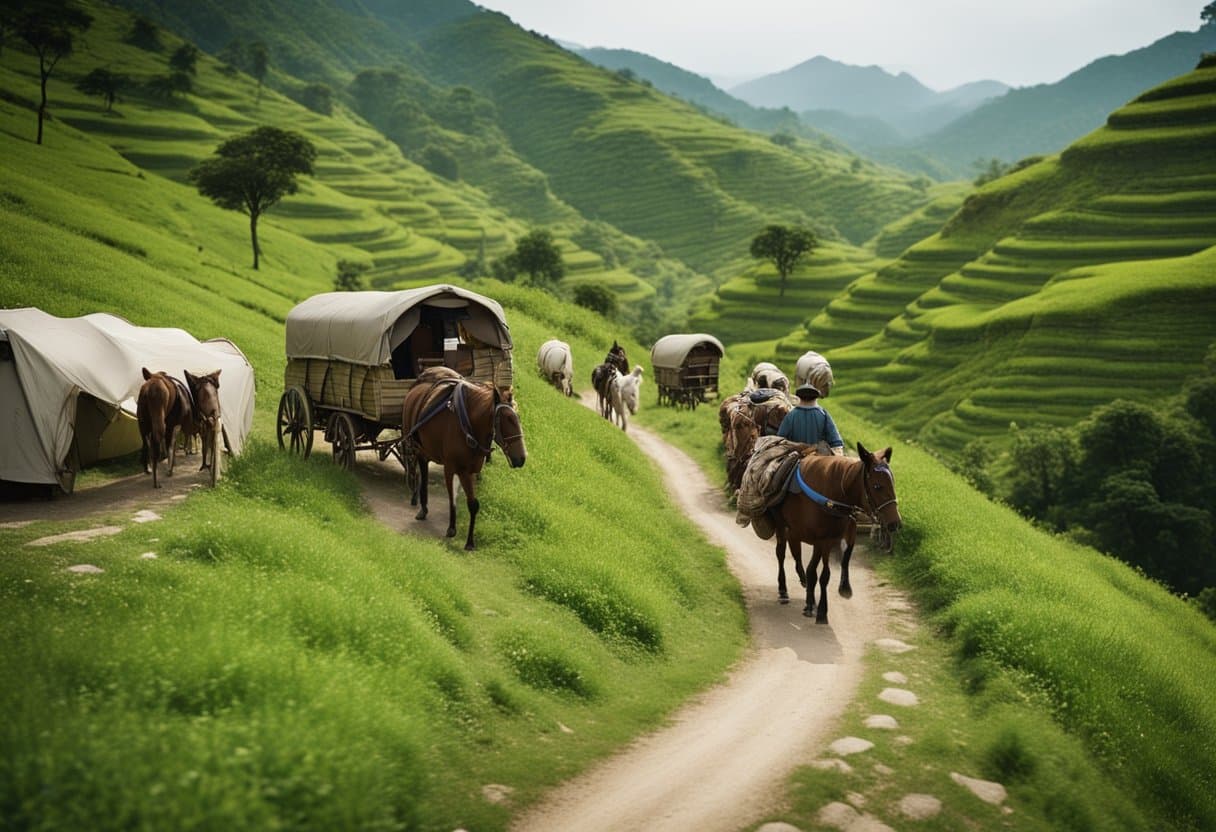
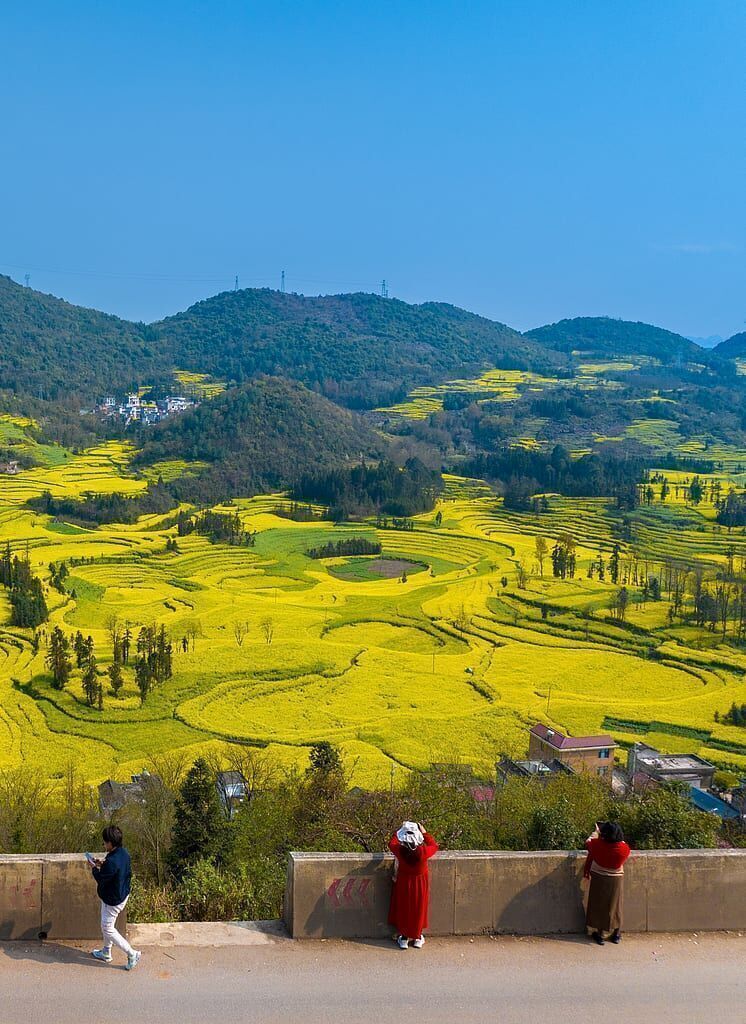
Beyond the sanctuary of the courtyard wall, Shengguantun maintains its slow, ancient pulse. As the morning mist begins to pull back from the terraced fields, I walk down the narrow stone lane that skirts the estate. The aesthetic continuity between the sanctuary and the village is striking. On one side stands the quiet, minimalist retreat; on the other, generations-old courtyard homes where farmers stack split firewood against cob walls. Green moss fills the deep crevices between grey paving stones. A pack mule wanders past, its worn brass bell giving off a dry, rhythmic chime that lingers in the damp air long after the animal has turned the corner.
This is the alchemy of combining wabi-sabi with modern minimalism: it elevates the weathered, the rustic, and the impermanent by giving them light and space. The sharp lines of glass and steel do not displace the weathered textures of Yunnan; rather, they act as a frame, turning rain-stained clay and rough timber into quiet works of art.
By midday, the cloud cover fractures, sending a broad blade of golden sunlight across the raw concrete floor of my room. I sit by the low window, watching dust motes suspend themselves in the warm beam. In conventional luxury resorts, one pays for service and sensory indulgence. In Shengguantun, you pay for the rare privilege of having your senses restored—the rough touch of natural linen, the aroma of rain on clay, and the long, undisturbed silence of a day moving at its own pace.

读过之后,想来住几天吗?
朴归山居 · 云南升官屯 — 22°C 的东方侘寂旅居。
相关阅读
The Quiet Luxury of Yunnan: Where Wabi-sabi Meets Western Minimalism(云南旅居)
Beyond the crowds of Dali, a hidden valley in Yunnan unfolds
Yunnan's Hidden Glamping Paradise: Where Wabi-Sabi Meets Western Minimalism(云南旅居)
Among Yunnan's mist-wrapped mountains, a new breed of wilder
Wabi-Sabi and the Wired Life: A Digital Nomad's Yunnan(云南旅居)
In the mist-wrapped mountains of Yunnan, ancient Chinese imp