Beyond the crowded trails of southwestern China, Qujing offers something far more enduring: a sanctuary of muted limesto
At six in the morning, the damp air off Haifeng Wetland carries the faint smell of cold limestone and burnt reed. I am sitting on a low bench carved from a single slab of salvaged pine, holding a cup of coarse local green tea. Outside the window, fog rolls over the karst peaks like grey ink dropped onto wet wash paper. There are no tour buses here at dawn, only the rhythmic clank of a solitary water buffalo bell somewhere in the tall grasses.
Qujing is often treated as a brief pause on the way to the tropics of Xishuangbanna or the historic courtyards of Dali. Yet, if you stay long enough to let its quiet rhythm take hold, this high-plateau region in eastern Yunnan reveals a profound, understated beauty. It is a landscape defined not by grand spectacles, but by subtle textures: lime-washed walls, pale clay soil, and water that winds through ancient stone valleys.
The Quiet Edge of Haifeng
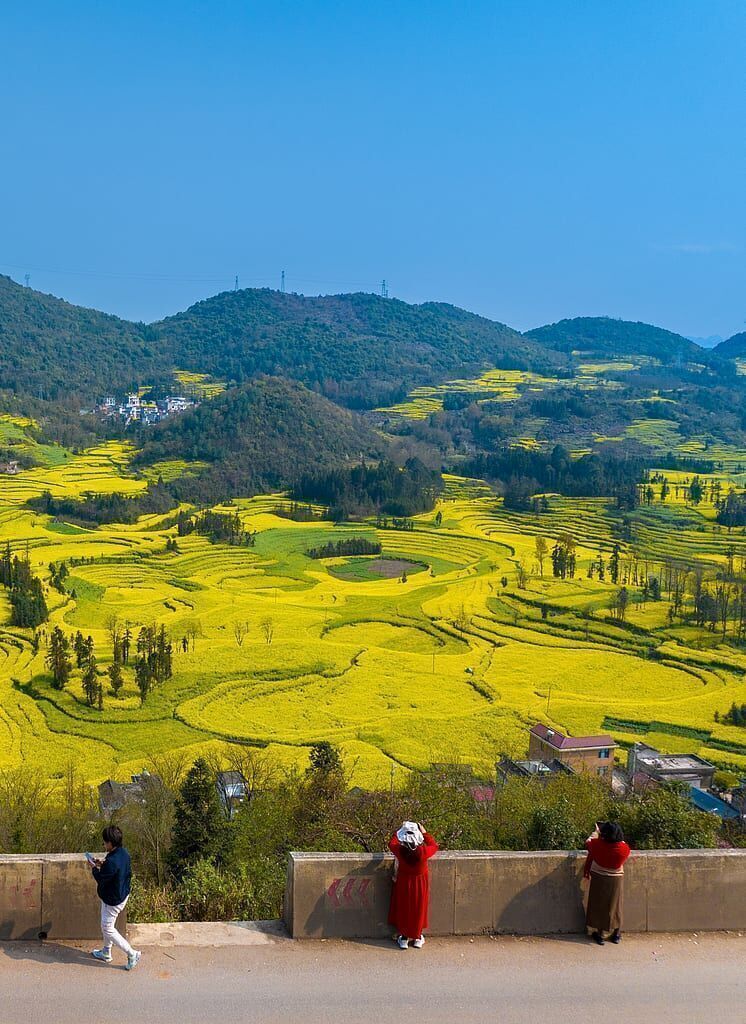
Located in Zhanyi District, Haifeng Wetland is an undisturbed maze of shallow water bodies, submerged reeds, and sharp limestone bluffs. While most visitors head south toward the famous rapeseed blooms in early spring, the wetland in late autumn and winter offers a minimalist purity that speaks directly to the soul.
If you plan to visit, base yourself in a private retreat near Zhanyi rather than the city center. Hire a private vehicle for the morning—navigating the narrow rural access roads requires local familiarity—and aim to arrive just as the first grey light touches the peaks. Pack a dense wool throw and a stainless thermos; the plateau breeze carries a sharp edge before midday. Walking the unpaved earth paths around the water takes two or three slow hours. Leave your phone in your coat pocket and listen to the whisper of dry stems bowing to the wind.
Plates of Cured Time
A luxury travel experience in Qujing is not found in gilded dining rooms, but in the elemental authenticity of its food. In an unassuming brick courtyard near the city’s edge, I spent an afternoon watching a master carver prepare Xuanwei ham. Cured in the cool mountain air using only local salt and time, the meat resembles aged dark mahogany, translucent at the edges.
When fried gently in its own rendered fat over white-hot charcoal in an iron skillet, the ham yields a complex, savory richness that rivals any jamón ibérico. Pair it with fresh buckwheat cakes dipped in bitter mountain honey and a bowl of wild mushroom broth simmered in an unglazed terracotta pot. For an authentic taste, seek out small, family-run eateries that cure their own meats in deep clay cellars rather than polished modern establishments.
Wandering Jiulong’s Waterways
An hour’s drive east brings you toward the Jiulong (Nine Dragons) Waterfalls. While a popular spot during peak hours, visiting in the late afternoon—when daytime tour groups begin to clear—transforms the experience. The water falls across ten tiered terraces of travertine rock, smoothed by millennia of flow.
Instead of taking the electric cart, walk the stone trail that traces the riverbank. Look for the small, moss-covered platforms near the lower cascades where the mist creates a soft, perpetual drizzle. Sit for twenty minutes on the cool stone. The roar of the water becomes a tactile texture, washing away the mental noise of long-distance travel.
Practical Notes for the Unhurried Traveler
To experience Qujing in this tranquil frame of mind, timing and preparation are essential:
Qujing teaches us the luxury of subtraction. In stripping away the superfluous, you are left with what truly matters: clear air, aged stone, and the quiet satisfaction of a day well lived.
读过之后,想来住几天吗?
朴归山居 · 云南升官屯 — 22°C 的东方侘寂旅居。
相关阅读
The Quiet Luxury of Yunnan: Where Wabi-sabi Meets Western Minimalism(云南旅居)
Beyond the crowds of Dali, a hidden valley in Yunnan unfolds
Yunnan's Hidden Glamping Paradise: Where Wabi-Sabi Meets Western Minimalism(云南旅居)
Among Yunnan's mist-wrapped mountains, a new breed of wilder
Wabi-Sabi and the Wired Life: A Digital Nomad's Yunnan(云南旅居)
In the mist-wrapped mountains of Yunnan, ancient Chinese imp