
In the quiet mountain valleys of Yunnan, Shengguantun offers a refined stillness where raw volcanic stone, burnt oak, an
Have you ever listened to the way morning light settles onto raw lime mortar before the rest of the world wakes?
Here in Shengguantun, a ancient village tucked quietly into the terraced folds of Yunnan, daybreak does not arrive with a flash. It slides in sideways, pale gray and cool, resting first on the chipped edge of my unglazed stoneware tea cup. I am sitting on a low bench of reclaimed cedar on the veranda of a restored courtyard house. Below me, steam rises from a brew of wild-harvested raw Pu’er tea, carrying the scent of damp forest floor, dried plum, and old wood. The morning mountain air is sharp enough to taste, crisp with the pine scent of the surrounding ridges and the lingering smoke of last night’s dried corn cob fires.
For three weeks, this has been my anchor. Shengguantun is not a place you hurry through with a camera and a checklist. It is a village built from the earth it rests upon—stacked volcanic fieldstones, heavy clay roof tiles darkened by decades of rain, and thick rammed-earth walls that hold the slow warmth of the afternoon sun well into the chill of night. In recent years, a handful of thoughtful architects have quietly stepped into this landscape, transforming derelict farmsteads into sanctuaries of understated luxury. They have left the cracked timber pillars and mossed stone foundations intact, pairing them with expansive sheets of frameless glass, brushed steel fixtures, and heated slate floors. The result is a rare harmony: Western minimalism stripped of its sterile coldness, infused instead with the soulful, imperfect warmth of traditional Yunnanese craft.
Stepping out from the courtyard, the village unfolds in a series of narrow, flagstone alleys. The soundscape is delightfully spare. There is the dry *scrape-scrape* of an elder’s bamboo broom against the cobblestones, the distant, hollow clink of a brass bell on a grazing mule, and the continuous trickle of mountain spring water running through subterranean stone channels carved beneath the footpaths. The local builders understood proportion and light in a way that modern city planners have long forgotten. Walls curve around ancient walnut trees rather than cutting them down; narrow gaps between gables create dramatic vertical shafts of shade where blue smoke from hearth fires curls upward like ink in water.
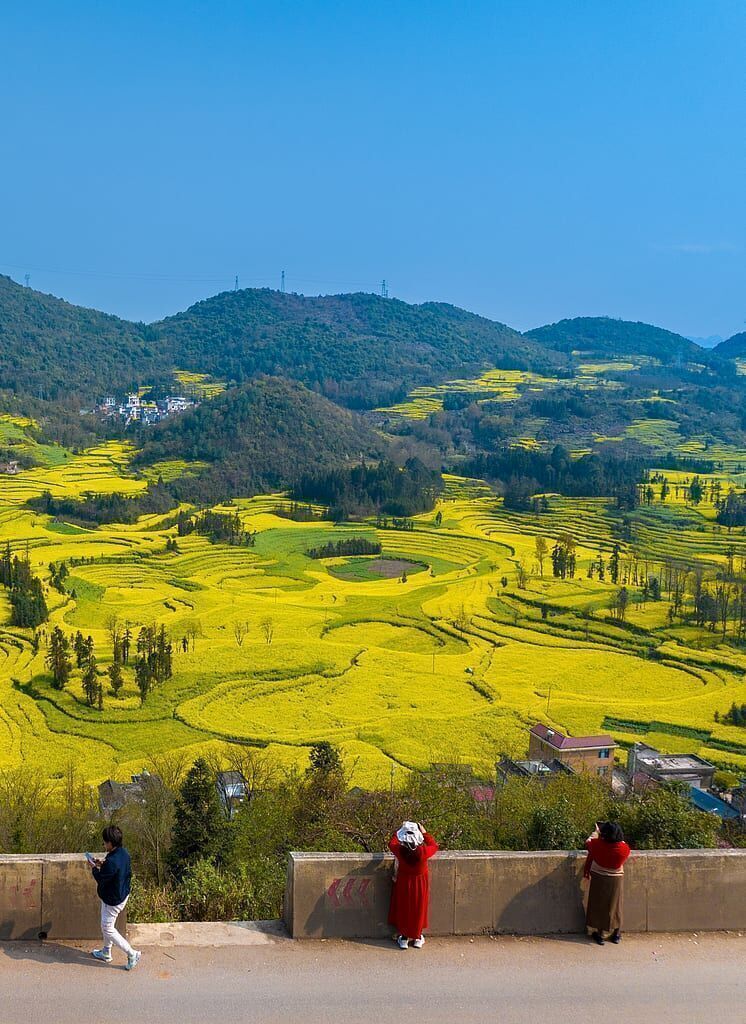
By mid-morning, the shadows shorten, exposing the rich textures of the valley. A walk through Shengguantun leads naturally toward the village edge, where agricultural fields stretch out in geometric ribbons of indigo and rust. Here, life moves to an ancient beat. Farmers in faded indigo aprons tend to plots of broad beans and wild mustard greens, their movements unhurried and rhythmic.
Midday calls for lunch at a small, reservation-only courtyard kitchen tucked behind an unmarked wooden gate. There are no menus here; the food arrives based on what was gathered from the mountainsides that morning. A heavy clay pot arrives bubbling with wild matsutake broth, rich with yellow chicken oil and scented with crushed ginger. It is accompanied by handmade buckwheat noodles served on cold river stones, paired with fermented mountain radish and pork preserved in lard and sea salt. It is food of incredible restraint and profound depth—simple ingredients elevated by patience and fire.
In the late afternoon, as the sky shifts to a deep, translucent sapphire, the village draws inward. This is the hour to return to the sanctuary of your room. The best stays here do not overwhelm with golden embellishments or modern noise. Instead, luxury is defined by space, silence, and tactile quality: the weight of hand-loomed linen bedding, the subtle fragrance of dried cedar shavings placed in linen sachets, and a deep soaking tub carved from a single block of local gray granite, positioned to look out across the tiled rooftops as the stars begin to emerge.
Shengguantun asks nothing of you except your presence. It invites you to notice the subtle beauty of a cracked clay tile, the changing weight of the wind through the pines, and the luxurious comfort of doing absolutely nothing. To visit here is to remember that true refinement is not about accumulation, but about stripping away everything unnecessary until only light, texture, and time remain.
***
### Practicalities for the Observant Traveler
**Getting There:** Shengguantun is best reached via a private driver from Dali or Lincang. The final ascent weaves through winding mountain passes; arrange for your lodge to meet you at the village entrance, as vehicles cannot navigate the narrow interior flagstone alleys.
**When to Visit:** October through November brings crisp, clear days, yellowing gingko canopy, and the autumn harvest. April and May offer soft wild orchids and fresh mountain tea picking.
**Where to Stay:** Look for design-led retreats that emphasize heritage restoration, such as those employing native stone, heated slate floors, and open courtyard layouts that honor the traditional *sanheyuan* spatial geometry.

读过之后,想来住几天吗?
朴归山居 · 云南升官屯 — 22°C 的东方侘寂旅居。
相关阅读
The Quiet Luxury of Yunnan: Where Wabi-sabi Meets Western Minimalism(云南旅居)
Beyond the crowds of Dali, a hidden valley in Yunnan unfolds
Yunnan's Hidden Glamping Paradise: Where Wabi-Sabi Meets Western Minimalism(云南旅居)
Among Yunnan's mist-wrapped mountains, a new breed of wilder
Wabi-Sabi and the Wired Life: A Digital Nomad's Yunnan(云南旅居)
In the mist-wrapped mountains of Yunnan, ancient Chinese imp